

Client Overview
A Large Regional Bank with Multi-Line Financial Operations
Our client is a large regional bank serving retail customers, commercial clients, and institutional relationships across multiple U.S. states. Operating a full suite of products including retail banking, mortgage lending, commercial credit, and treasury services, the bank depends on timely, accurate cross-system data to manage risk, serve customers, and meet regulatory reporting obligations.
The Business Challenge
Three Business-Critical Systems. Zero Integration. Decisions Made on Yesterday's Data.
The core banking system owned transactions and accounts. The CRM held customer relationships. The treasury platform managed positions and liquidity. None of these systems shared data with each other, and every cross-system insight required manual extraction and reconciliation.
Our Solution
A Centralized Banking Analytics Platform on Microsoft Fabric: Core Banking, CRM, and Treasury Unified
OptroniX designed and delivered a unified data integration and analytics architecture that brought all three source systems into a single OneLake environment, established a governed transformation layer, and delivered near-real-time Power BI dashboards that eliminated manual reporting entirely.
Core Banking System Integration
The core banking platform was connected to Microsoft Fabric OneLake via Fabric Data Factory pipelines using both full and incremental load patterns. Transaction records, account data, product holdings, and balance positions were ingested with full audit trail preservation and automated retry logic to ensure zero data loss across the 10M plus transaction volume.
CRM Integration via PySpark API Pipelines
CRM data was extracted using PySpark notebooks connected to the CRM API with full pagination handling, rate limit management, and delta extraction for incremental updates. Customer records, relationship history, interaction logs, opportunity pipelines, and product interest data were ingested and aligned to the banking data model in OneLake.
Treasury Data Integration
Treasury positions, interest rate exposure, liquidity metrics, and investment portfolio data were extracted from the treasury platform and ingested into OneLake. For the first time, treasury data was made available alongside retail and commercial banking data in a single governed environment, enabling enterprise-level risk and liquidity views.
Cross-System Customer Entity Resolution
PySpark notebooks applied systematic customer entity resolution across core banking and CRM using deterministic key matching on account identifiers and probabilistic matching on name and contact fields. This produced a unified customer golden record that correlated all product relationships, transaction history, and CRM context for every customer in the bank.
Unified Banking Analytics Gold Layer
Business-ready Gold layer datasets were materialized as semantic views and Delta tables in OneLake, organized by domain: retail analytics, commercial banking, treasury performance, and enterprise risk. Each domain dataset is ready for Power BI consumption with no additional preparation required by the analytics team.
Near-Real-Time Power BI Dashboards
Automated pipeline refresh schedules replaced all overnight batch cycles, delivering near-real-time analytics across transaction volumes, customer relationship health, treasury positions, and enterprise risk metrics. Power BI dashboards for executive, risk, commercial, and retail teams were built directly on the Gold layer with no intermediate data prep steps.
Technical Architecture
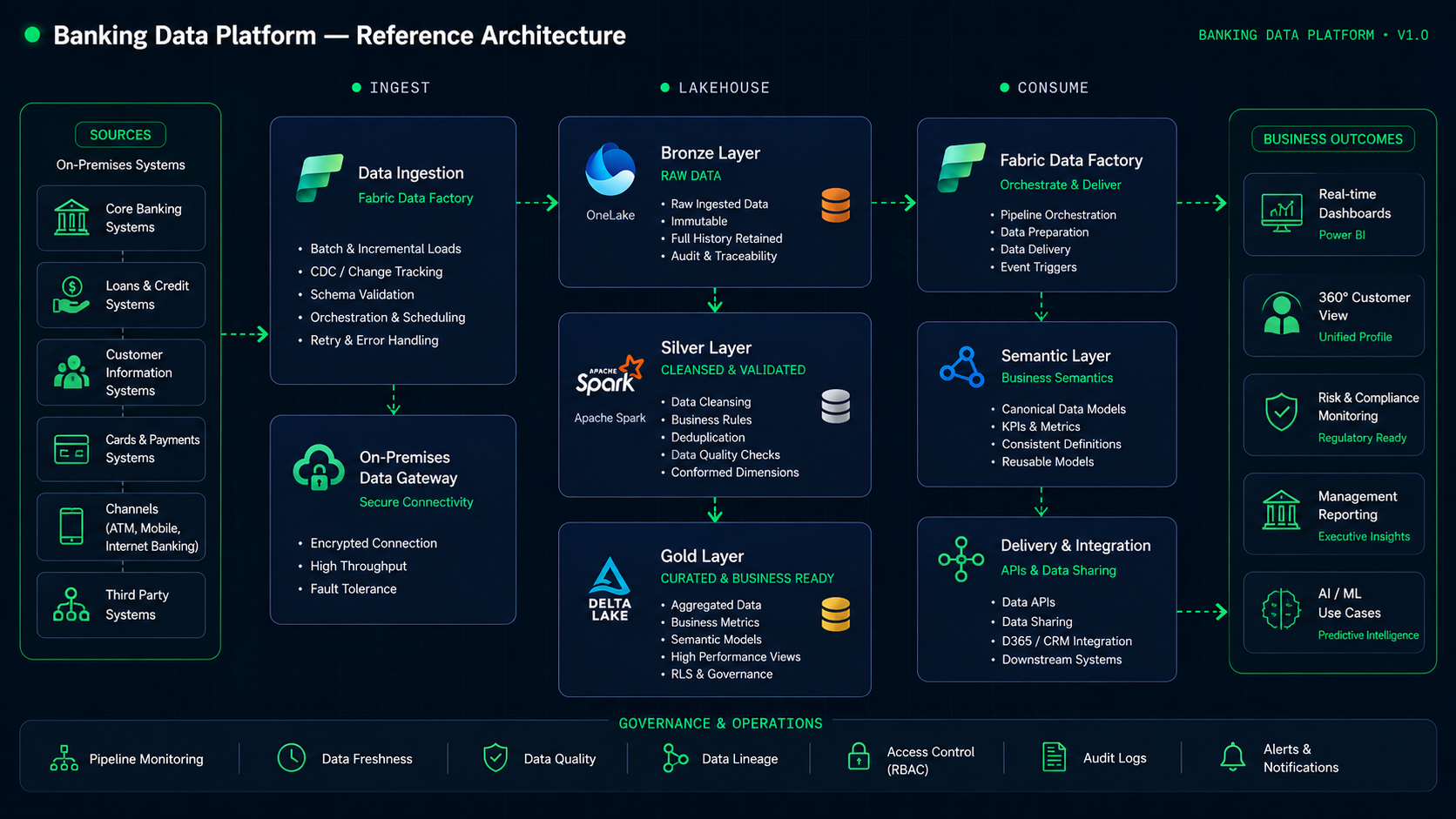
Three Systems, One Governed Platform
Core banking via Fabric Data Factory, CRM and treasury via PySpark API pipelines, all converging into Microsoft Fabric OneLake through Bronze raw ingestion, Silver entity resolution and transformation, into Gold domain datasets powering Power BI across all business lines.
Results and Business Impact
Three Systems. One Platform. Real-Time Banking Intelligence.
"Having our core banking data, CRM, and treasury all feeding one platform changed how we run the bank. Our product teams can now see the full picture of a customer relationship without calling three different departments. What used to take days to pull together now refreshes automatically."
Key Takeaways
What This Project Taught Us
Core Banking Integration Requires Deep Schema Understanding
Core banking systems store data in complex normalized schemas that require banking domain expertise to interpret correctly. Rushing to pipeline data without understanding the business meaning of each table leads to analytics that look right but carry hidden errors. Schema discovery is not overhead, it is the foundation of accurate reporting.
Customer Entity Resolution Is the Hardest Part of Banking Analytics
A customer in the core banking system, the CRM, and the treasury platform are rarely stored under the same identifier. Building a reliable golden record requires combining deterministic key matching with probabilistic name and contact matching, and it is consistently the most technically complex deliverable in any multi-system banking integration project.
Near Real-Time Does Not Require Streaming
For most banking analytics use cases, high-frequency incremental batch loads deliver sufficient freshness without the operational complexity of event streaming. Replacing a 48-hour batch cycle with a 15-minute incremental pipeline is genuinely transformational for business users, and it costs a fraction of what a full streaming architecture would require.
Domain-Organized Gold Datasets Multiply Business Value
Organizing Gold layer outputs by business domain, such as retail analytics, commercial banking, treasury performance, and enterprise risk, rather than by source system means every future report or AI use case built on the platform takes days instead of weeks. The investment in well-structured Gold datasets pays back across every downstream team that ever touches the platform.