

Client Overview
A Full-Service, Member-Owned Financial Institution
Our client is a not-for-profit credit union serving hundreds of thousands of members across multiple U.S. states. As a member-owned institution providing personal banking, mortgage lending, and business services, data accuracy and compliance are mission-critical priorities for their operations.
The Business Challenge
Fragmented Data Across Legacy Systems Was Crippling Reporting Speed and Accuracy
Decades of organic growth had left the organization with multiple siloed on-premises SQL Server systems, making timely and accurate reporting nearly impossible.
Our Solution
A Multi-Layer Data Platform on Microsoft Fabric, Built for Governance and Scale
OptroniX designed and delivered a Medallion Architecture pipeline following the Bronze, Silver, and Gold layering pattern purpose-built for the financial services context.
Secure On-Premises Connectivity
Established a secure, high-throughput connection between the client's SQL Server environments and Microsoft Fabric using the On-Premises Data Gateway. This eliminated manual exports and enabled automated, event-driven ingestion directly from source systems.
Bronze Layer: Raw Ingestion
Fabric Data Factory pipelines were configured to perform full and incremental loads from all 50+ source tables. Pipeline orchestration included retry logic, dependency management, and automated alerting to ensure no data loss even during partial outages.
Silver Layer: Transformation and Validation
PySpark notebooks executed complex business transformations including deduplication, referential integrity validation, and schema normalization. Over 200 data quality rules were enforced, automatically quarantining records that failed validation thresholds for human review.
Gold Layer: MRM and D365 Integration
Clean, validated datasets were surfaced as semantic views inside OneLake for direct consumption by the MRM platform. D365 was configured to receive enriched member and product data, eliminating all manual reconciliation work that previously took 2 to 3 days per cycle.
Pipeline Monitoring and Governance
A full pipeline monitoring dashboard was delivered with automated alerting on pipeline health, data freshness, and validation failure rates. Full end-to-end data lineage was established, tracing every figure in every report back to its source system, transformation logic, and ingestion timestamp.
Technical Architecture
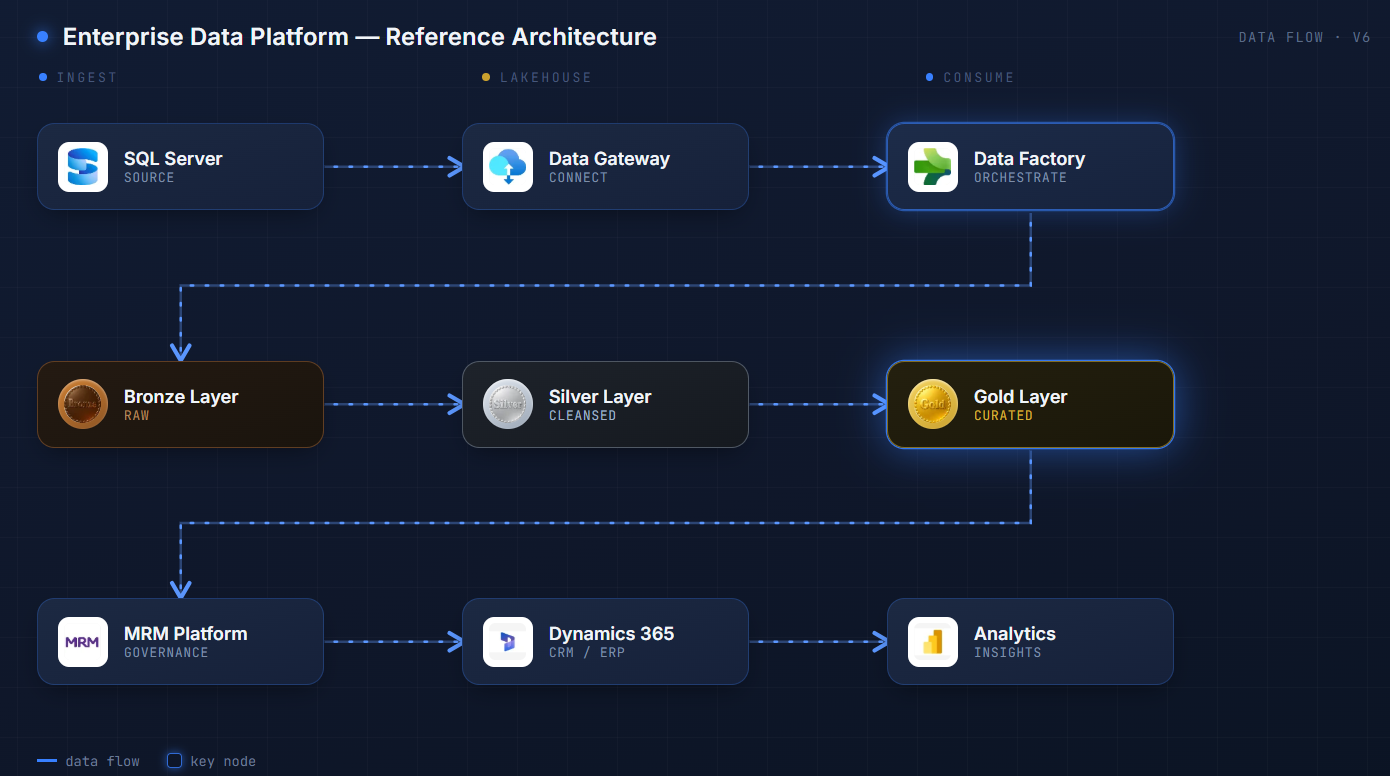
End-to-End Data Flow
From on-premises SQL Server through the On-Premises Data Gateway into Microsoft Fabric, across the Bronze, Silver, and Gold Medallion layers, through to MRM and Dynamics 365 as downstream consumers.
Results and Business Impact
Measurable Outcomes, Delivered at Scale
"The platform OptroniX built gave us something we never had before: a single, trusted view of our member data that updates automatically. What used to take our team days to compile now happens in minutes."
Key Takeaways
What This Project Taught Us
Medallion Architecture Works for Financial Services
The Bronze-Silver-Gold layering pattern is ideally suited for regulated industries where auditability and data lineage are non-negotiable requirements that must be baked in from day one.
On-Premises Infrastructure Is Not a Blocker
With the right connectivity layer, legacy SQL Server environments can feed modern cloud platforms without requiring full infrastructure overhauls or expensive lift-and-shift migrations.
Build Governance In from the Start
Embedding data quality rules and validation at the Silver layer rather than as an afterthought dramatically reduces downstream issues and makes compliance reporting straightforward instead of painful.
D365 and Fabric Are Built to Work Together
Leveraging the native integration between Microsoft Fabric and Dynamics 365 eliminated significant custom engineering, reduced overall project complexity, and cut time-to-delivery by several weeks.