
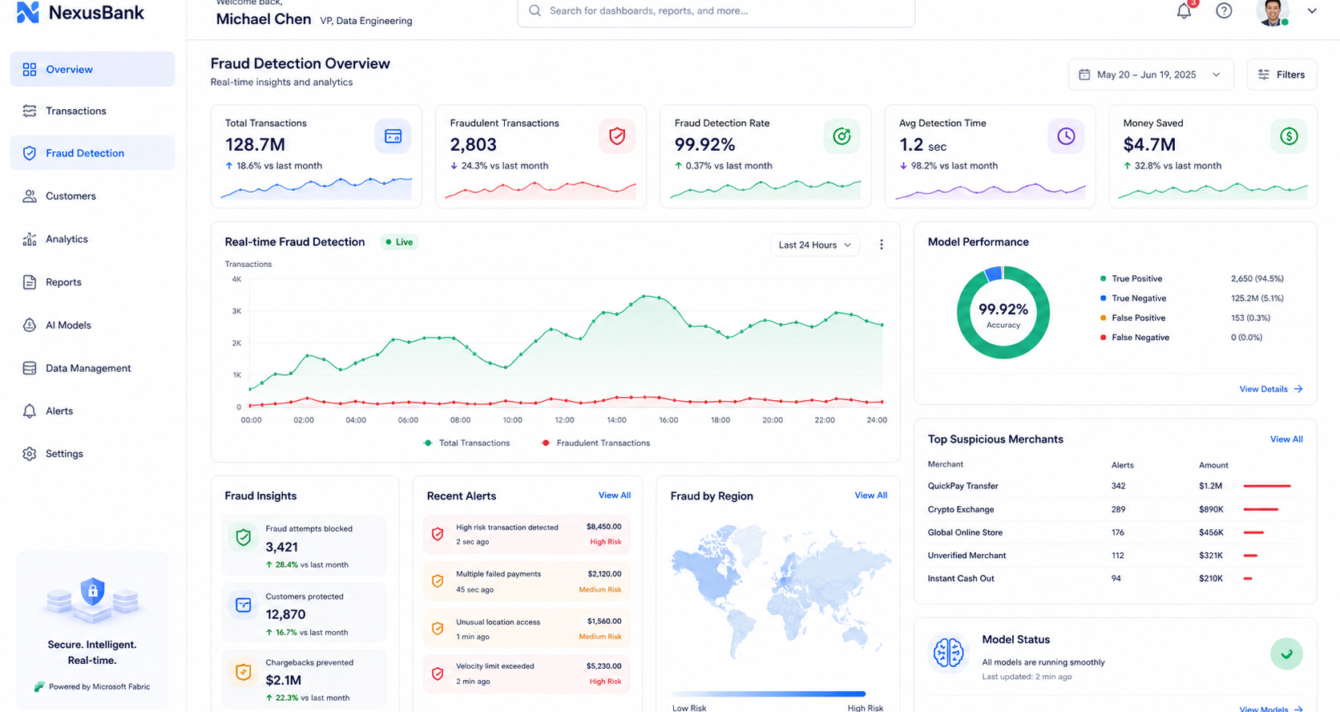
How We Reduced Fraud Detection Time from 45 Minutes to 1 Second Using Microsoft Fabric
The Wake-Up Call
This case examines how a digital-first financial institution restructured its data platform after rapid growth exposed critical architectural limitations.
Nexus Financial scaled into a multi-product platform serving over two million customers, but its systems were not built for real-time analytics or cross-functional use.
The result: A system that worked operationally but failed strategically.
The Mess They Started With
| Component | Technology |
|---|---|
| Batch processing | Google Cloud Dataproc |
| Transactional database | PostgreSQL |
| Data lake | Google Cloud Storage |
| Orchestration | Python + Cron |
| Streaming | Not implemented |
Reality: Data was everywhere. Insights were nowhere.
Four Problems That Needed Fixing
Data Silos
Transactions, logs, and operational data were disconnected. Reports required manual stitching across systems.
Slow Decisions
Fraud detection ran in batch mode, making responses too late to prevent loss.
High Cost
Scaling compute increased costs without improving performance.
No AI Capability
System supported reporting only. No real-time analytics or predictive models.
The Decision: Rebuild with Microsoft Fabric
- Unified data layer with OneLake
- Built-in analytics and machine learning
- Consumption-based scaling
How the Architecture Was Rebuilt
OneLake (Central Layer): All datasets unified into a single storage layer using shortcuts instead of duplication.
Real-Time Streaming: Transactions processed continuously with real-time fraud detection.
Dynamic Compute: Auto-scaling compute replaced persistent clusters, reducing idle cost.
Integrated AI: Models for fraud, segmentation, and recommendations deployed directly within Fabric.
AI Use Cases Implemented
| Use Case | Outcome |
|---|---|
| Fraud Detection | Real-time transaction monitoring |
| Risk Scoring | Automated credit evaluation |
| Segmentation | Behavior-based grouping |
| Recommendations | Personalized product offers |
Results After Implementation
| Metric | Before | After |
|---|---|---|
| Fraud latency | Minutes–Hours | Under 1 second |
| Cost | $187k | $100k |
| Reports | 2 days | 4 hours |
| Query time | Hours | Seconds |
| Conversion | 6% | 10.2% |
Key Learnings
- Start with a high-impact use case (fraud detection)
- Avoid unnecessary data movement
- Involve business stakeholders early
- Track costs continuously
A modern data platform is not just a technology shift. It is a change in how data is structured, governed, and used to drive decisions.
Ready to Modernize Your Data & Analytics Stack?
Book a free consultation to explore real-time analytics, Microsoft Fabric, AI automation, and enterprise data engineering solutions.