
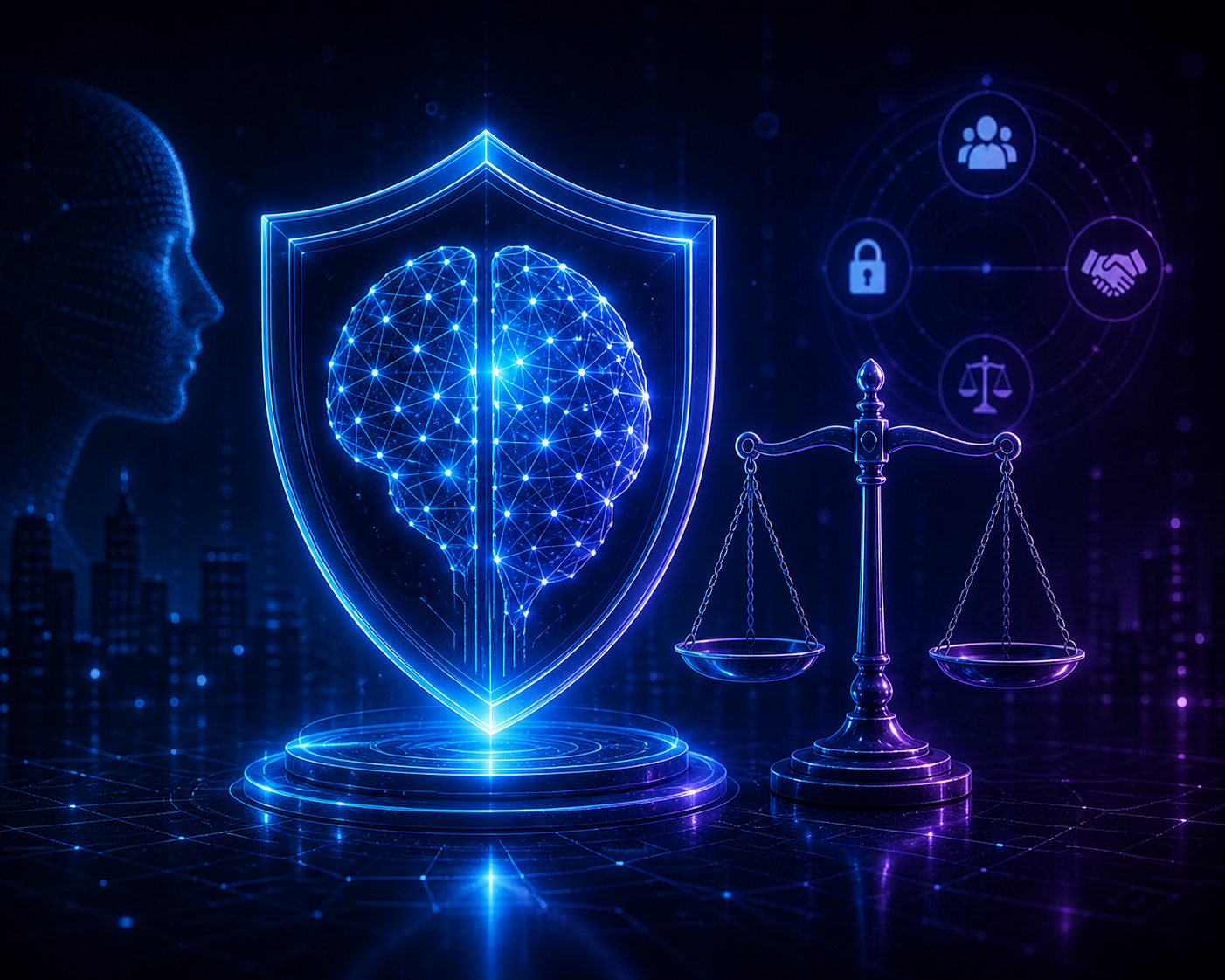
An AI system just rejected your loan application. You don’t know why. No explanation was given. No human reviewed it. The algorithm made its decision in milliseconds and moved on to the next application.
This is not a future scenario. This is happening right now, today, in banks, hospitals, hiring departments, and housing platforms across the world. And in most cases, nobody is watching.
The real danger of artificial intelligence is not the robots you see in movies. It is the silent, invisible systems running quietly in the background, making decisions about your money, your job, your healthcare, and your housing without anyone asking whether those decisions are fair, safe, or even accurate.
Microsoft saw this problem coming. And they built a framework to fix it.
“The most dangerous AI systems are not the ones
making headlines. They are the ones nobody is auditing.”
The Silent Risk
SECTION 1: Not All AI Is the Same
Before we talk about Responsible AI, we need to clear up one of the biggest misconceptions in tech today. When people say “AI” they almost always mean ChatGPT or image generators. But artificial intelligence is a much larger world than that, and understanding its layers is the first step to understanding why responsible AI matters.
Artificial Intelligence is the broadest category. It refers to any system that mimics human intelligence, including reasoning, deciding, planning, and learning. Every technology in this blog lives inside this umbrella.
Machine Learning sits inside AI. It refers to machines that learn patterns directly from data without being explicitly programmed with rules. This is the technology quietly deciding whether you qualify for a loan, whether your job application moves forward, and what your insurance premium will be. It runs on data. It learns from history. And if that history contains bias, the model learns that bias too.
Deep Learning sits inside Machine Learning. It uses neural networks, which are layers of mathematical functions inspired loosely by the human brain, to find patterns too complex for traditional algorithms. Deep learning powers facial recognition, medical image analysis, and voice assistants.
Generative AI is the newest and smallest circle. It is AI that creates new content including text, images, code, and audio. ChatGPT is Generative AI. DALL-E is Generative AI. Copilot is Generative AI. This is what everyone calls “AI” today, but it represents only a small fraction of the AI systems actually affecting people’s lives.
The models quietly running your life are not Generative AI. They are classical Machine Learning systems. And almost nobody is auditing them.
“GenAI gets all the attention. Classical ML gets all the power.”
The Real Picture
SECTION 2: When AI Gets It Wrong — Real Consequences
These are not hypothetical scenarios. These are documented cases of AI systems causing real harm to real people.
Privacy at Scale: In 2023, Italy banned ChatGPT after discovering that user data was being collected without proper consent. The consequence was an immediate regulatory ban and global scrutiny that forced OpenAI to change how it handles European user data.
Gender Bias in Finance: Apple Card’s credit algorithm gave women credit limits up to ten times lower than men with identical financial profiles. Couples with shared assets were receiving dramatically different limits based on gender alone. The result was public backlash and a regulatory investigation by the New York Department of Financial Services.
Housing Discrimination: SafeRent, an AI powered tenant screening service, was found to systematically screen out Black renters and housing voucher holders. The company agreed to a 2.2 million dollar class action settlement. Thousands of people had been denied housing by an algorithm.
Disability Bias in Hiring: A 2024 study from the University of Washington found that ChatGPT consistently ranked resumes with disability related content lower than identical resumes without it. The research raised serious questions about using AI tools in hiring pipelines without proper bias testing.
These failures share one common thread: the systems were deployed before anyone asked whether they were fair, reliable, or safe. Microsoft’s Responsible AI Framework exists precisely to prevent this from happening.
“AI failures are not just bugs in a system. They are discrimination
at scale, and the victims rarely even know it happened.”
Why This Matters
SECTION 3: The Four Forces Making Responsible AI Unavoidable
Organizations are not adopting Responsible AI purely out of goodwill. Four powerful forces are making it a business necessity whether companies like it or not.
Regulatory Compliance is the first and most immediate force. Governments around the world are passing laws that regulate how AI systems must behave. The EU AI Act, data protection regulations, and financial sector rules are creating legal obligations that companies cannot ignore. Non-compliance means fines, bans, and lawsuits.
Reputational Risk is the second force. In the age of social media, a single AI discrimination story can go viral overnight. The Apple Card story, the SafeRent case, the ChatGPT ban in Italy all became global headlines. A single irresponsible AI deployment can permanently damage a brand that took decades to build.
Consumer and Investor Trust is the third force. Customers are becoming more aware of how AI affects their lives and they are choosing brands that treat them fairly. Investors are increasingly applying ESG criteria to their decisions, and AI ethics falls squarely under Social and Governance categories.
Internal Accountability and Governance is the fourth force. As AI systems become more embedded in core business operations, organizations need internal frameworks to track who built what, why decisions were made, and who is responsible when something goes wrong. Without governance, accountability becomes impossible.
SECTION 4: Microsoft’s Six RAI Principles
Microsoft’s Responsible AI framework is built on six core principles. These are not marketing slogans. Each one maps directly to specific engineering tools inside Azure Machine Learning.
Fairness and Inclusiveness
AI systems must treat all people equally and avoid producing different outcomes for similar groups. Whether an AI is guiding medical treatment, evaluating loan applications, or screening job candidates, it must make consistent decisions for people with similar profiles regardless of their gender, ethnicity, age, or disability status.
In Azure Machine Learning, the Fairness Assessment component of the Responsible AI dashboard allows developers to detect and measure these disparities before a model ever reaches production. It surfaces where a model is treating groups differently so engineers can fix it before real users are affected.
Reliability and Safety
A model that works perfectly on average but fails for a specific group of people is not a reliable model. It is a dangerous one. AI systems must operate consistently across all conditions, handle unexpected inputs gracefully, and resist manipulation.
In Azure Machine Learning, the Error Analysis component gives developers a detailed view of exactly where and how a model fails. It uses decision tree visualizations to identify specific groups where error rates are significantly higher than the overall benchmark, allowing targeted retraining rather than guesswork.
Privacy and Security
AI systems are built on data, and that data often contains sensitive personal information. Responsible AI requires that this data be protected at every stage. Azure Machine Learning enables developers to build secure configurations that restrict access, encrypt data both in transit and at rest, and audit compliance policies to identify vulnerabilities before they become breaches.
Transparency
When an AI makes a decision that affects someone’s life, that person deserves to know why. Transparency means being able to explain what a model did and why, in terms both technical experts and ordinary people can understand.
In Azure Machine Learning, the Model Interpretability and Counterfactual What-If components generate human readable explanations of model behavior, from broad global feature importance down to the specific reason a single loan application was approved or rejected. The Responsible AI Scorecard produces a shareable PDF report that communicates model health and compliance to all stakeholders.
Accountability
AI systems make decisions, but humans must remain responsible for those decisions. Azure Machine Learning enforces accountability through MLOps capabilities that track the full model lifecycle: who published a model, what changes were made, and when it was deployed. This creates a complete audit trail that organizations can reference when questions arise.
Inclusiveness
AI should be designed to benefit everyone, not just the majority. Inclusive AI means considering the needs of people with disabilities, people from diverse cultural backgrounds, and people who interact with technology in different ways. This principle runs through every other principle in the framework and ensures no group is left behind.
“Building AI that is fast is engineering. Building AI that is fair,
safe, and explainable is responsibility. Microsoft built a
framework to do both at the same time.”
– The Standard We Should Hold AI To
CONCLUSION:
The AI systems making decisions about your life right now were not all built with fairness in mind. Many were built for speed, accuracy, and profit. The consequences of that approach are sitting in court records, regulatory reports, and the lives of people who were denied a loan, an apartment, or a job by an algorithm they never saw.
Microsoft’s Responsible AI Framework does not make AI perfect. No framework can. But it creates the principles, the accountability structures, and the engineering standards that make it possible to build AI that is worthy of human trust.
Fairness, reliability, privacy, transparency, accountability, and inclusiveness are not optional features. They are the difference between AI that serves people and AI that harms them.
The question is not whether your organization will eventually face pressure to adopt Responsible AI. The question is whether you will build it in from the start, or scramble to fix it after something goes wrong.